
-

Poor Physician Adherence to Clinical Guidelines in Hypertension—Time for Physicians to Face Clinical Inertia
Poor Physician Adherence to Clinical Guidelines in Hypertension—Time for Physicians to Face Clinical Inertia
-

Dietary sodium intake does not alter renal potassium handlingand blood pressure in healthy young males
Dietary sodium intake does not alter renal potassium handlingand blood pressure in healthy young males
-

Management of hypertensive disorders inpregnancy: a Position Statement of the EuropeanSociety of Hypertension Working Group‘Hypertension in Women’
Management of hypertensive disorders inpregnancy: a Position Statement of the EuropeanSociety of Hypertension Working Group‘Hypertension in Women’
-
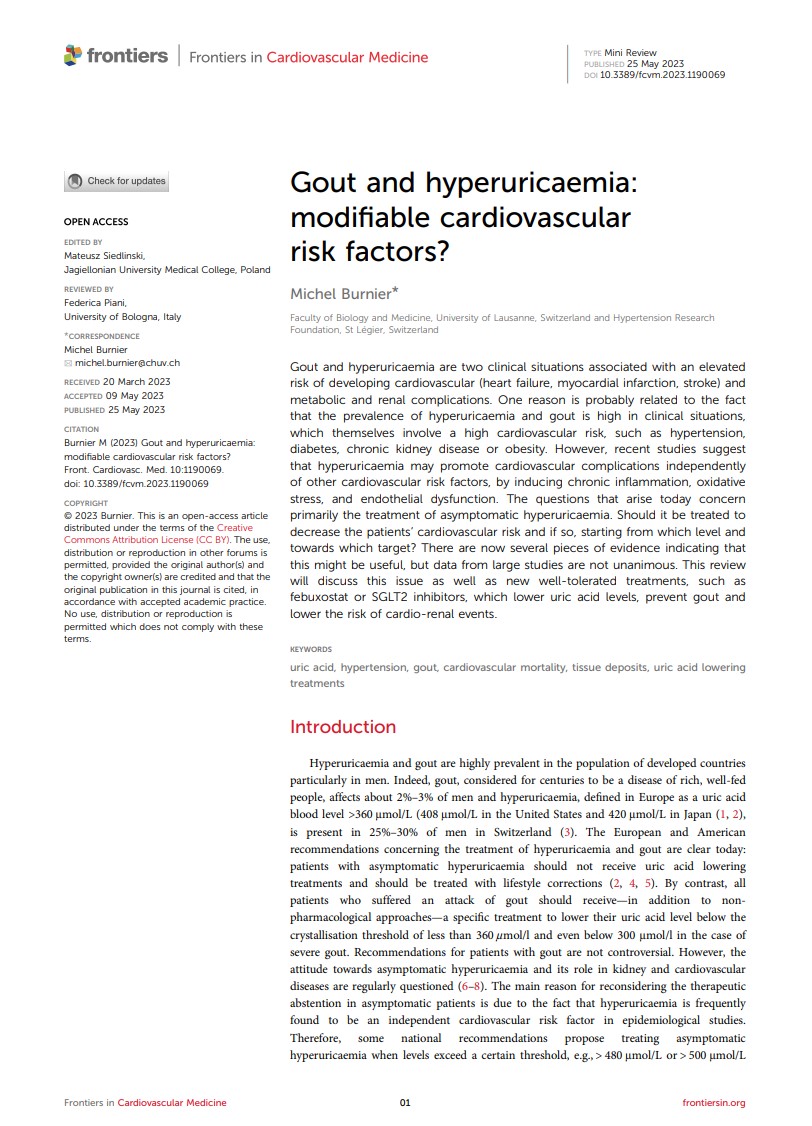
Gout and hyperuricaemia: modifiable cardiovascular risk factors?
Gout and hyperuricaemia are two clinical situations associated with an elevated risk of developing cardiovascular (heart failure, myocardial infarction, stroke) and metabolic and renal complications. One reason is probably related to the fact that the prevalence of hyperuricaemia and gout is high in clinical situations, which themselves involve a high cardiovascular risk, such as hypertension, diabetes, chronic kidney disease or obesity. However, recent studies suggest that hyperuricaemia may promote cardiovascular complications independently of other cardiovascular risk factors, by inducing chronic inflammation, oxidative stress, and endothelial dysfunction. The questions that arise today concern primarily the treatment of asymptomatic hyperuricaemia. Should it be treated to decrease the patients’ cardiovascular risk and if so, starting from which level and towards which target? There are now several pieces of evidence indicating that this might be useful, but data from large studies are not unanimous. This review will discuss this issue as well as new well-tolerated treatments, such as febuxostat or SGLT2 inhibitors, which lower uric acid levels, prevent gout and lower the risk of cardio-renal events.
-

Women’s health, cardiovascular risk and hypertension: the perspective still needs to improve
In recent decades, great efforts have been dedicated to the recognition and promotion of women’s health as in the prevention and management of health conditions in women [1–5]. Important initiatives have also been implemented by institutions supporting biomedical research, such as the US National Institutes of Health and the European Commission, to increase the participation of women in the medical sciences and to incorporate more systematically sex (a biological characteristic) and gender (a social construct) analyses into the design of research projects [2,3]. An analysis of more than 1.5 million medical research papers has shown that integrating more women into research projects is associated with greater attention to gender- and sex-related factors in disease-specific research, which should be globally beneficial for women’s health globally [6].
-
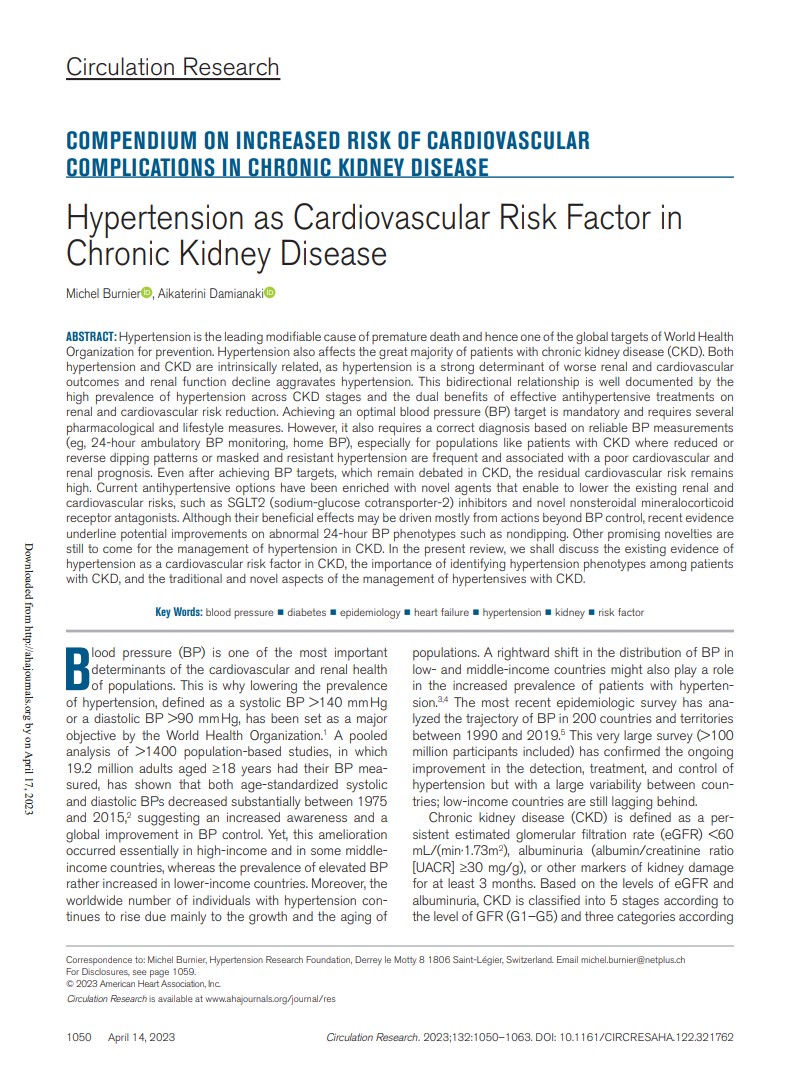
COMPENDIUM ON INCREASED RISK OF CARDIOVASCULAR COMPLICATIONS IN CHRONIC KIDNEY DISEASE
ABSTRACT: Hypertension is the leading modifiable cause of premature death and hence one of the global targets of World Health Organization for prevention. Hypertension also affects the great majority of patients with chronic kidney disease (CKD). Both hypertension and CKD are intrinsically related, as hypertension is a strong determinant of worse renal and cardiovascular outcomes and renal function decline aggravates hypertension. This bidirectional relationship is well documented by the high prevalence of hypertension across CKD stages and the dual benefits of effective antihypertensive treatments on renal and cardiovascular risk reduction. Achieving an optimal blood pressure (BP) target is mandatory and requires several pharmacological and lifestyle measures. However, it also requires a correct diagnosis based on reliable BP measurements (eg, 24-hour ambulatory BP monitoring, home BP), especially for populations like patients with CKD where reduced or reverse dipping patterns or masked and resistant hypertension are frequent and associated with a poor cardiovascular and renal prognosis. Even after achieving BP targets, which remain debated in CKD, the residual cardiovascular risk remains high. Current antihypertensive options have been enriched with novel agents that enable to lower the existing renal and cardiovascular risks, such as SGLT2 (sodium-glucose cotransporter-2) inhibitors and novel nonsteroidal mineralocorticoid receptor antagonists. Although their beneficial effects may be driven mostly from actions beyond BP control, recent evidence underline potential improvements on abnormal 24-hour BP phenotypes such as nondipping. Other promising novelties are still to come for the management of hypertension in CKD. In the present review, we shall discuss the existing evidence of hypertension as a cardiovascular risk factor in CKD, the importance of identifying hypertension phenotypes among patients with CKD, and the traditional and novel aspects of the management of hypertensives with CKD.
-
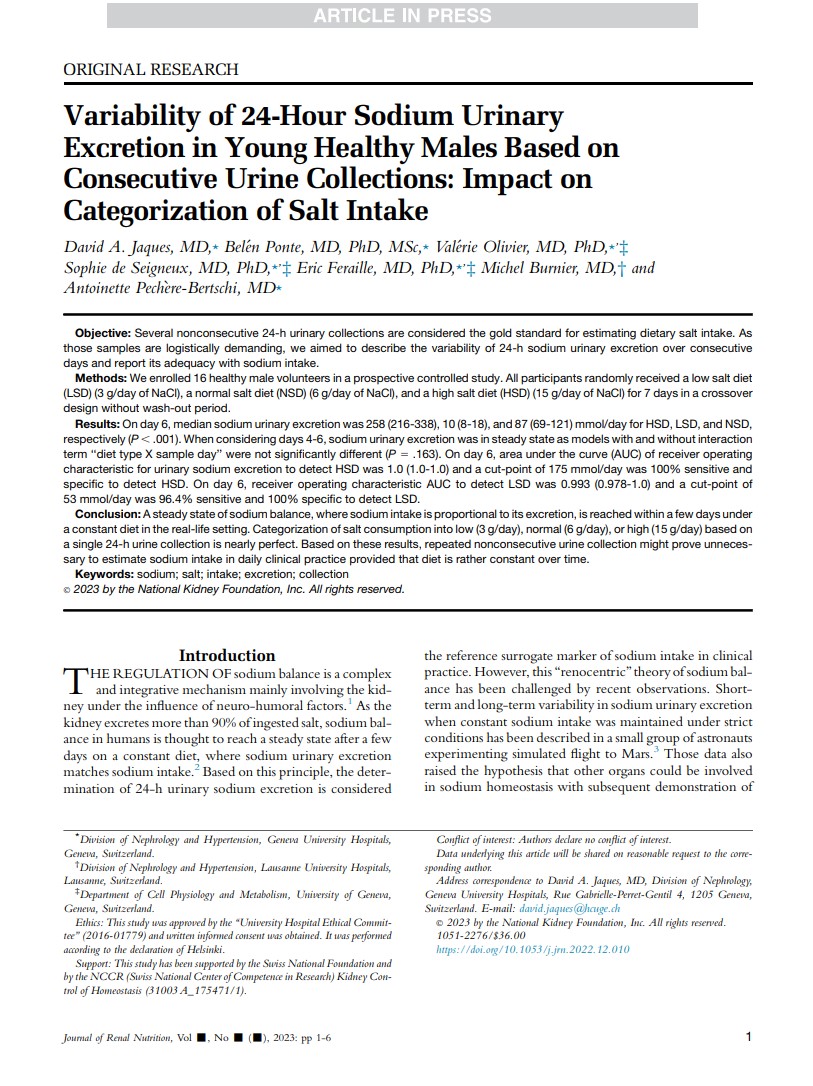
Variability of 24-Hour Sodium Urinary Excretion in Young Healthy Males Based on Consecutive Urine Collections: Impact on Categorization of Salt Intake
THE REGULATION OF sodium balance is a complex and integrative mechanism mainly involving the kidney under the influence of neuro-humoral factors.1 As the kidney excretes more than 90% of ingested salt, sodium balance in humans is thought to reach a steady state after a few days on a constant diet, where sodium urinary excretion matches sodium intake.2 Based on this principle, the determination of 24-h urinary sodium excretion is considered the reference surrogate marker of sodium intake in clinical practice. However, this ‘‘renocentric’’theory of sodium balance has been challenged by recent observations. Shortterm and long-term variability in sodium urinary excretion when constant sodium intake was maintained under strict conditions has been described in a small group of astronauts experimenting simulated flight to Mars.3 T
-
Defining intradialytic hypertension: the importance of measuring blood pressure accurately
The blood pressure (BP) profile of patients on maintenance hemodialysis (HD) is characterized by large fluctuations occurring within and between HD sessions. Indeed, during a typical HD session, BP decreases from pre- to postdialysis and generally increases gradually until the next dialysis session owing to salt and fluid retention. In observational studies, both intra- and interdialysis changes in BP have been associated with target-organ damage, cardiovascular events and mortality with a U-shape relationship, the incidence of clinical events increasing in patients with very low as well as very high BP values [1].
-
May Measurement Month 2017–2019: results from Switzerland
May Measurement Month (MMM) is an international screening campaign for arterial hypertension initiated by the International Society of Hypertension and endorsed by the World Hypertension League. Its aim is to raise the awareness of elevated blood pressure (BP) in the population worldwide. The goal of the present analyses is to assess the results obtained during three years of this campaign in Switzerland. Swiss data from MMM17 to MMM19 campaigns were used. BP and a questionnaire for basic demographic and clinical information were recorded for each participant. BP measurements and definition of arterial hypertension followed the standard MMM protocol. To assess BP control, European Society of Hypertension 2018 thresholds of <140>
-
Hypertension healthcare professional beliefs and behaviour regarding patient medication adherence: a survey conducted among European Society of Hypertension Centres of Excellence
The European Society of Cardiology and the European Society of Hypertension 2018 recommendations on the management of hypertension in adults state that three important factors contribute to the poor control of blood pressure (BP) in hypertension [1]. These factors are low patients’ adherence to nonpharmacological as well as to pharmacological treatments, therapeutic/physician inertia and deficiencies of healthcare systems in their approach to chronic diseases [1]. A partial or complete non-adherence to prescribed medications is very common in chronic ‘silent’ diseases, such as hypertension and dyslipidemia or diabetes [2]. In chronic diseases such as hypertension, the causes and implications of non-adherence are multidimensional and complex [3]. Thus, poor adherence not only limits a physician’s ability to achieve optimal BP control but also significantly impairs the capacity to reduce the patients’ cardiovascular risk [4] and the occurrence of severe clinical outcomes such as stroke, heart failure, coronary artery disease or chronic kidney diseases [3,5–7].


Recent articles
- Poor Physician Adherence to Clinical Guidelines in Hypertension—Time for Physicians to Face Clinical Inertia

- Dietary sodium intake does not alter renal potassium handlingand blood pressure in healthy young males

- Management of hypertensive disorders inpregnancy: a Position Statement of the EuropeanSociety of Hypertension Working Group‘Hypertension in Women’

- Gout and hyperuricaemia: modifiable cardiovascular risk factors?
- Women’s health, cardiovascular risk and hypertension: the perspective still needs to improve