FR
FR
latest news
-

Rhone-Alpes Symposium 2026
March 20 and 21, 2026
-

Poor Physician Adherence to Clinical Guidelines in Hypertension—Time for Physicians to Face Clinical Inertia
Poor Physician Adherence to Clinical Guidelines in Hypertension—Time for Physicians to Face Clinical Inertia
-

Dietary sodium intake does not alter renal potassium handlingand blood pressure in healthy young males
Dietary sodium intake does not alter renal potassium handlingand blood pressure in healthy young males
-

Management of hypertensive disorders inpregnancy: a Position Statement of the EuropeanSociety of Hypertension Working Group‘Hypertension in Women’
Management of hypertensive disorders inpregnancy: a Position Statement of the EuropeanSociety of Hypertension Working Group‘Hypertension in Women’
-
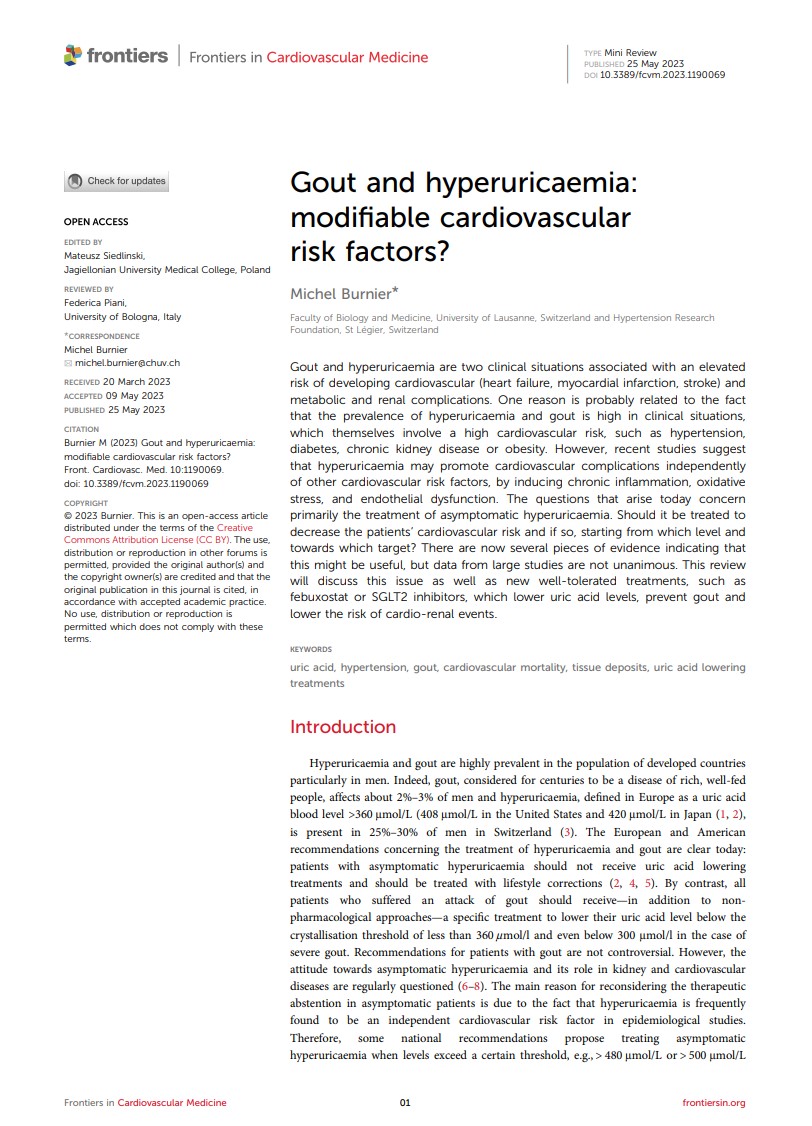
Gout and hyperuricaemia: modifiable cardiovascular risk factors?
Gout and hyperuricaemia are two clinical situations associated with an elevated risk of developing cardiovascular (heart failure, myocardial infarction, stroke) and metabolic and renal complications. One reason is probably related to the fact that the prevalence of hyperuricaemia and gout is high in clinical situations, which themselves involve a high cardiovascular risk, such as hypertension, diabetes, chronic kidney disease or obesity. However, recent studies suggest that hyperuricaemia may promote cardiovascular complications independently of other cardiovascular risk factors, by inducing chronic inflammation, oxidative stress, and endothelial dysfunction. The questions that arise today concern primarily the treatment of asymptomatic hyperuricaemia. Should it be treated to decrease the patients’ cardiovascular risk and if so, starting from which level and towards which target? There are now several pieces of evidence indicating that this might be useful, but data from large studies are not unanimous. This review will discuss this issue as well as new well-tolerated treatments, such as febuxostat or SGLT2 inhibitors, which lower uric acid levels, prevent gout and lower the risk of cardio-renal events.
-

Women’s health, cardiovascular risk and hypertension: the perspective still needs to improve
In recent decades, great efforts have been dedicated to the recognition and promotion of women’s health as in the prevention and management of health conditions in women [1–5]. Important initiatives have also been implemented by institutions supporting biomedical research, such as the US National Institutes of Health and the European Commission, to increase the participation of women in the medical sciences and to incorporate more systematically sex (a biological characteristic) and gender (a social construct) analyses into the design of research projects [2,3]. An analysis of more than 1.5 million medical research papers has shown that integrating more women into research projects is associated with greater attention to gender- and sex-related factors in disease-specific research, which should be globally beneficial for women’s health globally [6].