
-
-
-

20th Romandie Hypertension Day
Thursday, October 30, 2025 starting at 12:30 PM CHUVTissot Auditorium, BH8Rue du Bugnon 441005 Lausanne TOPIC: The Overlooked in Hypertension Organization: Prof. Grégoire Wuerzner (CHUV), Prof. Georg Ehret (HUG), Prof. Belén Ponte (HUG) Download the flyer Program: 12:30 PM - 1:30 PM Welcome reception1:30 PM - 1:40 PM Introduction Prof. G. WuerznerPart 1: Chair Prof. Georg Ehret1:40 PM - 2:10 PM Lecture – "Smart use of diuretics […]
-
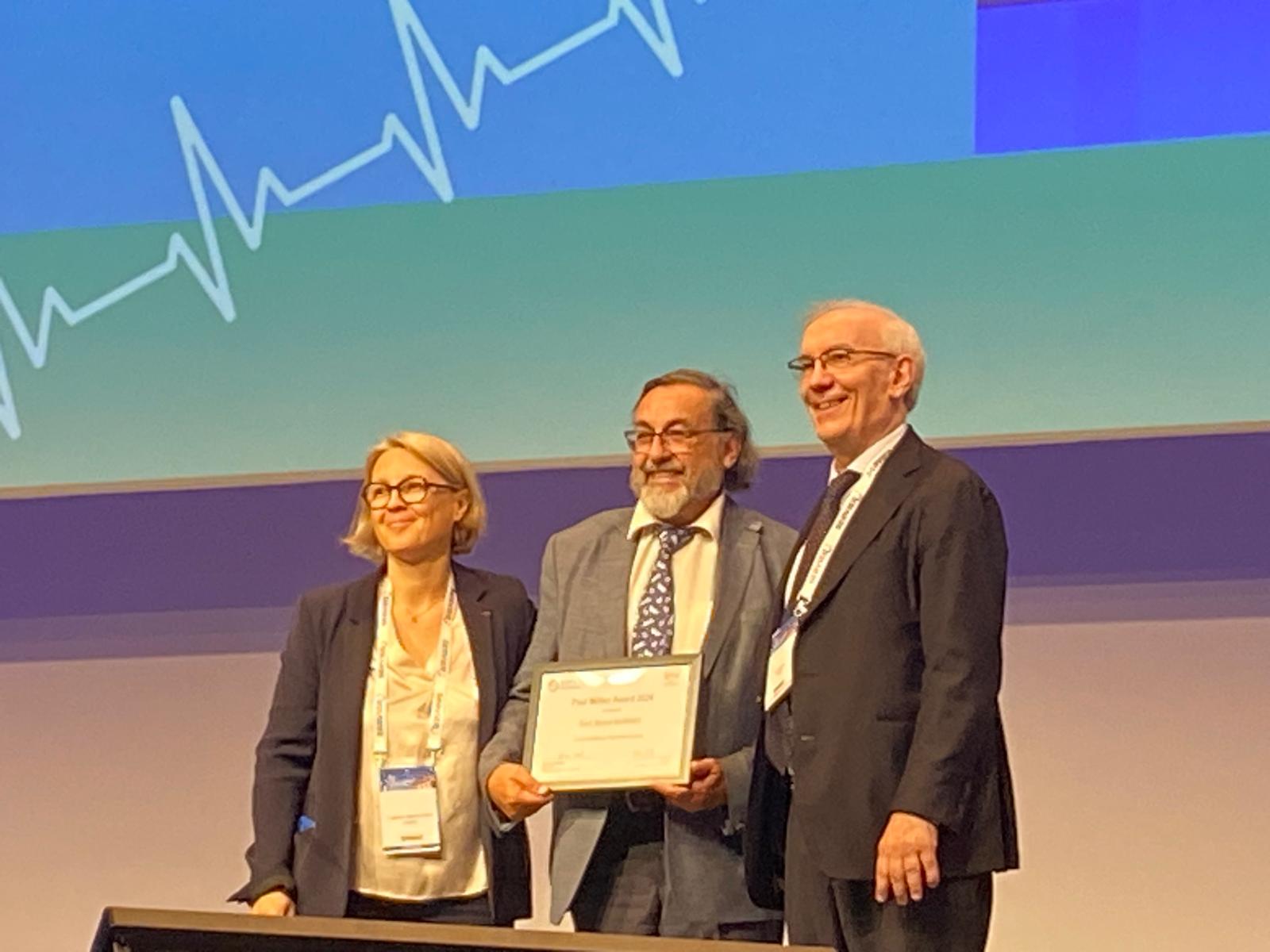
Prof. Hon. Michel Burnier received the Paul Milliez Award at the 33rd Meeting of the European Society of Hypertension in Berlin in May 2024
We are pleased to announce that Prof. Hon. Michel Burnier from Lausanne University has received the Paul Milliez Award from the European Society of Hypertension and the French Society of Hypertension. The Paul Milliez Award was created in 2004 and is awarded to a distinguished scientist/physician originating from a French speaking country in recognition of […]
-

Symposium in Memory of Jean-Pierre Guignard
Symposium in Honor of the Memory of Jean-Pierre Guignard June 21, 2024, Lausanne, Switzerland Venue Lausanne University Hospital (CHUV) Rue du Bugnon 46, 1005 Lausanne, Switzerland All information available on the Symposium website Throughout his career, Jean-Pierre Guignard was honored by the University of Lausanne (Prix de Cérenville 1970; Lauréat de l'Université 1970), by […]
-
-

Rhône-Alpes Symposium 2021
Update on Hypertension & Nephrology Schedule: from September 17th to 19th, 2021Venue of the event: Hôtel Victoria, Les Diablerets Event organised by the Hypertension Research Foundation Organizers:Prof. M. Burnier, LausanneProf. P.Y. Martin, GenevaProf. D. Fouque, LyonProf. B. Vogt, Bern With the support of Educational Grants from Alexion, Amgen, Baxter, B-Braun, Fresenius, GSK, Kyowa, Menarini, […]
-
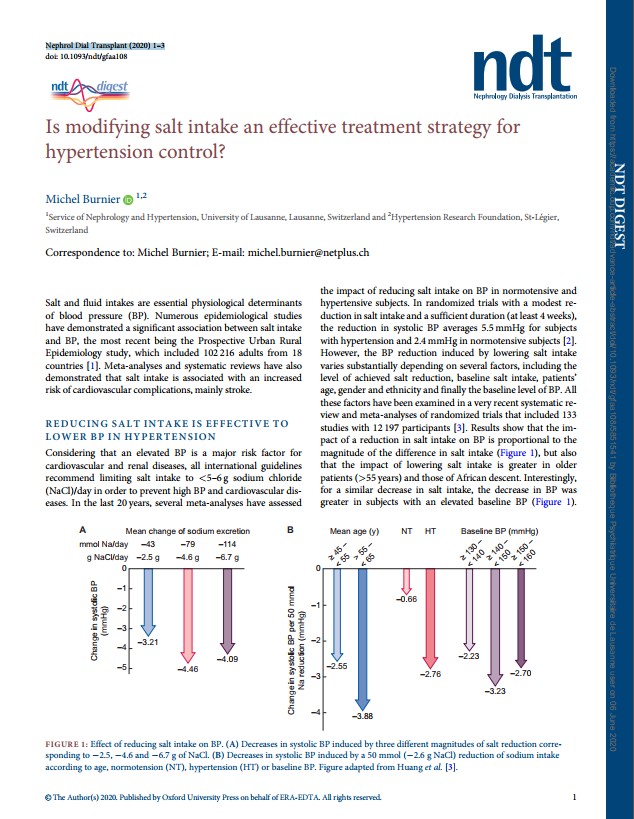
Is modifying salt intake an effective treatment strategy for hypertension control?
Salt and fluid intakes are essential physiological determinants of blood pressure (BP). Numerous epidemiological studies have demonstrated a significant association between salt intake and BP, the most recent being the Prospective Urban Rural Epidemiology study, which included 102 216 adults from 18 countries [1]. Meta-analyses and systematic reviews have also demonstrated that salt intake is associated with an increased risk of cardiovascular complications, mainly stroke.
-
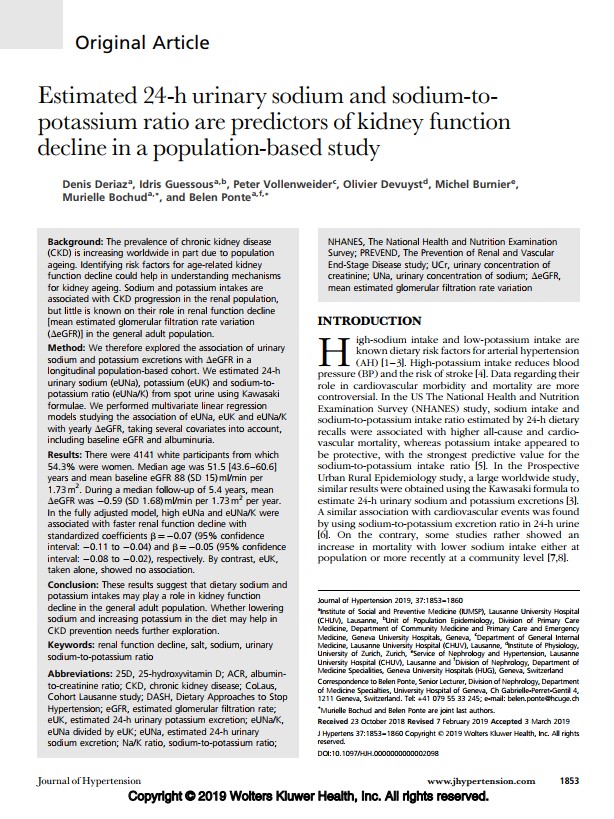
Estimated 24-h urinary sodium and sodium-to-potassium ratio are predictors of kidney function decline in a population-based study
High-sodium intake and low-potassium intake are known dietary risk factors for arterial hypertension (AH) [1–3]. High-potassium intake reduces blood pressure (BP) and the risk of stroke [4]. Data regarding their role in cardiovascular morbidity and mortality are more controversial. In the US The National Health and Nutrition Examination Survey (NHANES) study, sodium intake and sodium-to-potassium intake ratio estimated by 24-h dietary recalls were associated with higher all-cause and cardiovascular mortality, whereas potassium intake appeared to be protective, with the strongest predictive value for the sodium-to-potassium intake ratio [5]. In the Prospective Urban Rural Epidemiology study, a large worldwide study, similar results were obtained using the Kawasaki formula to estimate 24-h urinary sodium and potassium excretions [3]. A similar association with cardiovascular events was found by using sodium-to-potassium excretion ratio in 24-h urine [6]. On the contrary, some studies rather showed an increase in mortality with lower sodium intake either at population or more recently at a community level [7,8].


Recent articles
- Poor Physician Adherence to Clinical Guidelines in Hypertension—Time for Physicians to Face Clinical Inertia

- Dietary sodium intake does not alter renal potassium handlingand blood pressure in healthy young males

- Management of hypertensive disorders inpregnancy: a Position Statement of the EuropeanSociety of Hypertension Working Group‘Hypertension in Women’

- Gout and hyperuricaemia: modifiable cardiovascular risk factors?
- Women’s health, cardiovascular risk and hypertension: the perspective still needs to improve