
-
Dietary sodium intake does not alter renal potassium handlingand blood pressure in healthy young males
Dietary sodium intake does not alter renal potassium handlingand blood pressure in healthy young males
-

Management of hypertensive disorders inpregnancy: a Position Statement of the EuropeanSociety of Hypertension Working Group‘Hypertension in Women’
Management of hypertensive disorders inpregnancy: a Position Statement of the EuropeanSociety of Hypertension Working Group‘Hypertension in Women’
-
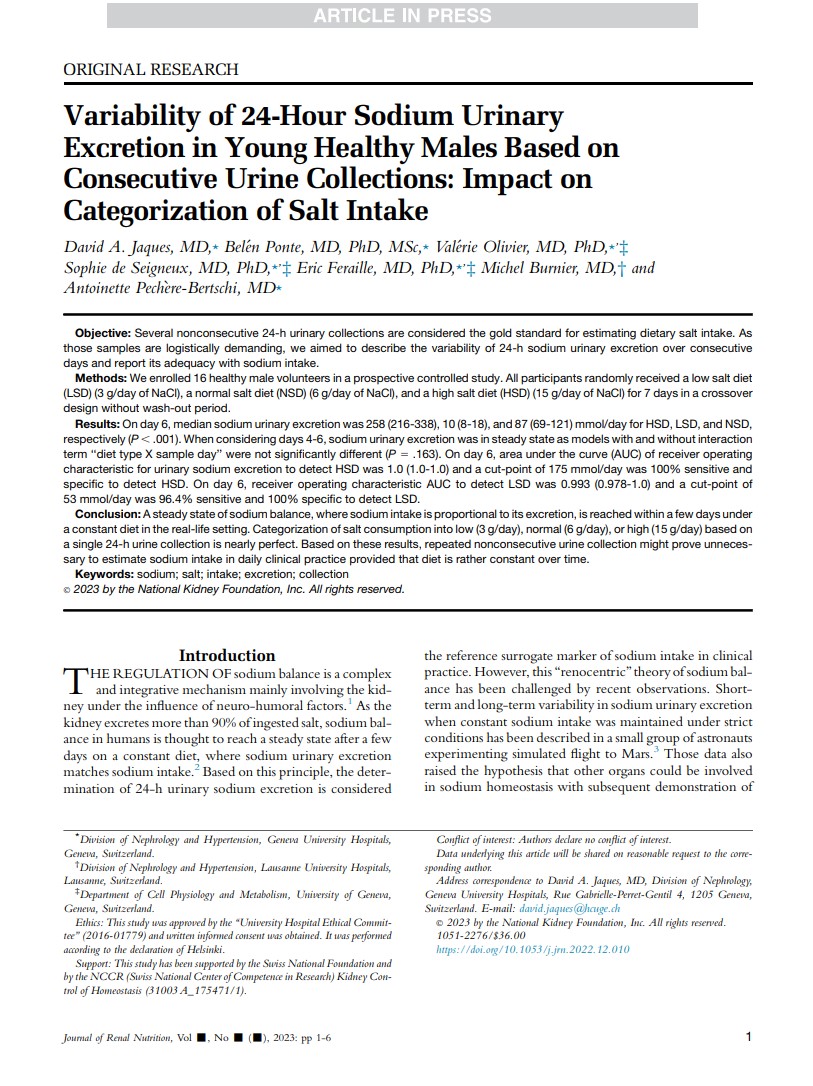
Variability of 24-Hour Sodium Urinary Excretion in Young Healthy Males Based on Consecutive Urine Collections: Impact on Categorization of Salt Intake
THE REGULATION OF sodium balance is a complex and integrative mechanism mainly involving the kidney under the influence of neuro-humoral factors.1 As the kidney excretes more than 90% of ingested salt, sodium balance in humans is thought to reach a steady state after a few days on a constant diet, where sodium urinary excretion matches sodium intake.2 Based on this principle, the determination of 24-h urinary sodium excretion is considered the reference surrogate marker of sodium intake in clinical practice. However, this ‘‘renocentric’’theory of sodium balance has been challenged by recent observations. Shortterm and long-term variability in sodium urinary excretion when constant sodium intake was maintained under strict conditions has been described in a small group of astronauts experimenting simulated flight to Mars.3 T
-
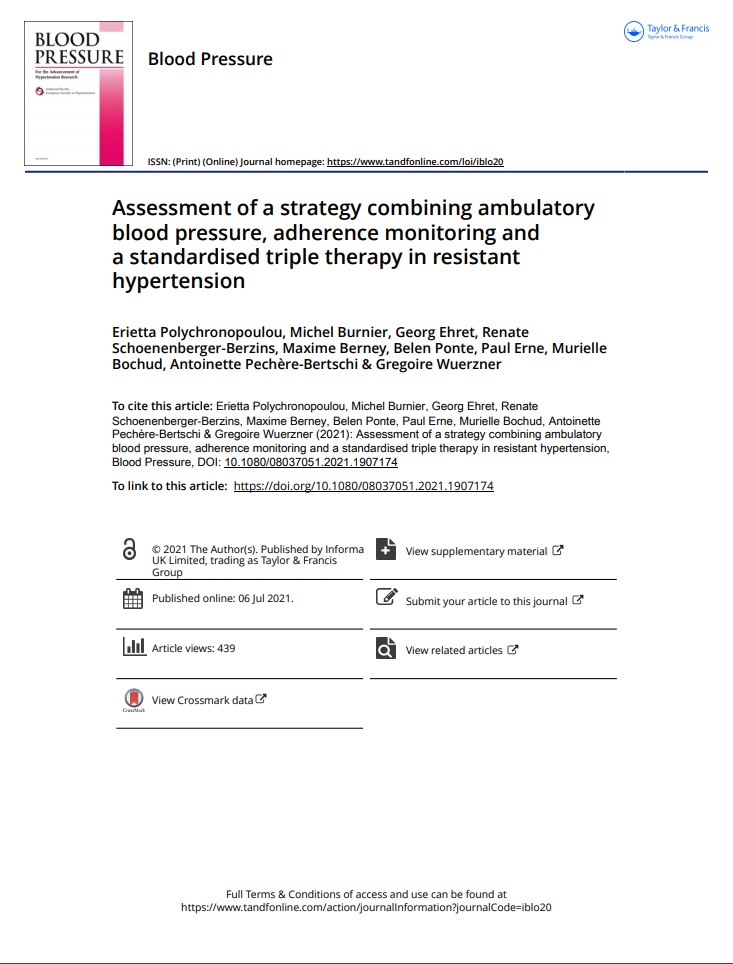
Assessment of a strategy combining ambulatory blood pressure, adherence monitoring and a standardised triple therapy in resistant hypertension
Hypertension is defined as resistant to therapy when the prescribed drug treatment fails to control blood pressure (BP) and to achieve recommended targets, and the inadequate BP control is confirmed by outof-office BP monitoring in patients whose adherence to therapy has been confirmed [1]. This definition implies that 3 antihypertensive drugs are prescribed at maximally tolerated doses with one of them being a diuretic. In recent years, additional definitions have appeared in the literature [2]. They include the concept of refractory hypertension, when BP remains uncontrolled with the use of 5 antihypertensive agents of different classes, including a long-acting thiazide-like diuretic and spironolactone, or controlled resistant hypertension, when BP falls below targets on 4 antihypertensive medications at maximal or maximally tolerated doses [2]. Frequently, however, uncontrolled hypertension is considered as ‘apparent’ rather than true resistant hypertension because BP has not been measured outside the office, drug adherence has not been assessed and other factors of pseudo-resistance have not been excluded [3].
-
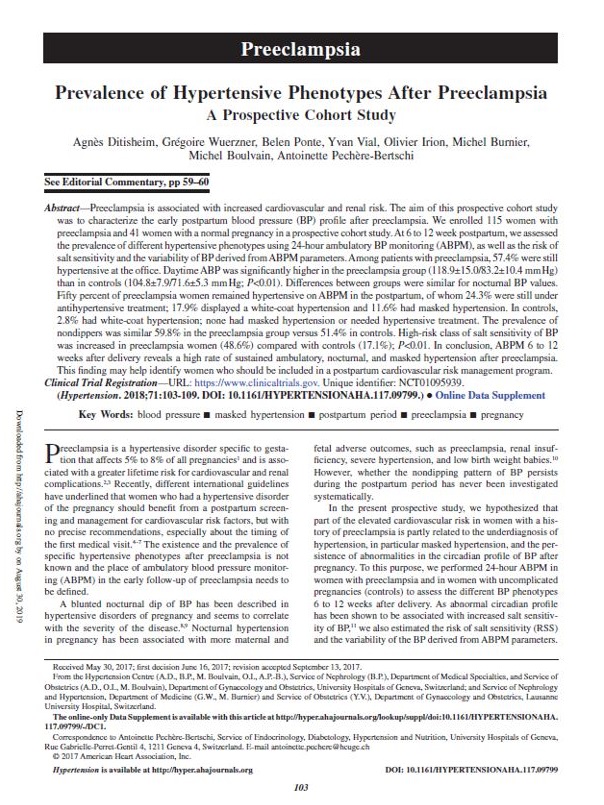
Prevalence of Hypertensive Phenotypes After Preeclampsia
Preeclampsia is a hypertensive disorder specific to gestation that affects 5% to 8% of all pregnancies1 and is associated with a greater lifetime risk for cardiovascular and renal complications.2,3 Recently, different international guidelines have underlined that women who had a hypertensive disorder of the pregnancy should benefit from a postpartum screening and management for cardiovascular risk factors, but with no precise recommendations, especially about the timing of the first medical visit.4–7 The existence and the prevalence of specific hypertensive phenotypes after preeclampsia is not known and the place of ambulatory blood pressure monitoring (ABPM) in the early follow-up of preeclampsia needs to be defined.
-

New Blood Pressure Targets: Much Ado About Nothing?
How can we accept the lowering of blood pressure targets in daily practice when more than half of treated hypertensive patients have blood pressure values above the "former" targets? The publication of new guidelines concerning the diagnosis of hypertension and the target blood pressure levels to be achieved routinely plunges us back into an almost Lelouch-like question: What was it all for?
-
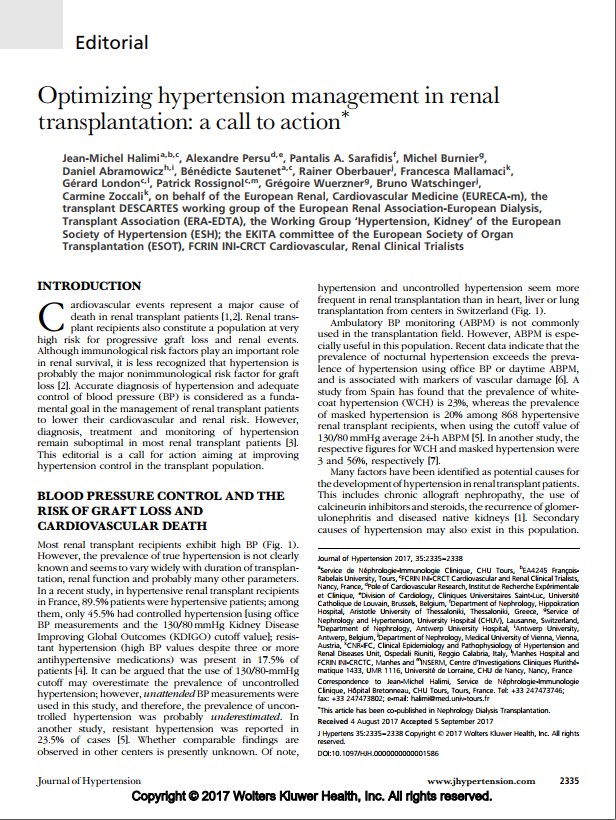
Optimizing hypertension management in renal transplantation: a call to action
Cardiovascular events represent a major cause of death in renal transplant patients [1,2]. Renal transplant recipients also constitute a population at very high risk for progressive graft loss and renal events. Although immunological risk factors play an important role in renal survival, it is less recognized that hypertension is probably the major nonimmunological risk factor for graft loss [2]. Accurate diagnosis of hypertension and adequate control of blood pressure (BP) is considered as a fundamental goal in the management of renal transplant patients to lower their cardiovascular and renal risk. However, diagnosis, treatment and monitoring of hypertension remain suboptimal in most renal transplant patients [3]. This editorial is a call for action aiming at improving hypertension control in the transplant population.


Recent articles
- Poor Physician Adherence to Clinical Guidelines in Hypertension—Time for Physicians to Face Clinical Inertia

- Dietary sodium intake does not alter renal potassium handlingand blood pressure in healthy young males

- Management of hypertensive disorders inpregnancy: a Position Statement of the EuropeanSociety of Hypertension Working Group‘Hypertension in Women’

- Gout and hyperuricaemia: modifiable cardiovascular risk factors?
- Women’s health, cardiovascular risk and hypertension: the perspective still needs to improve