-
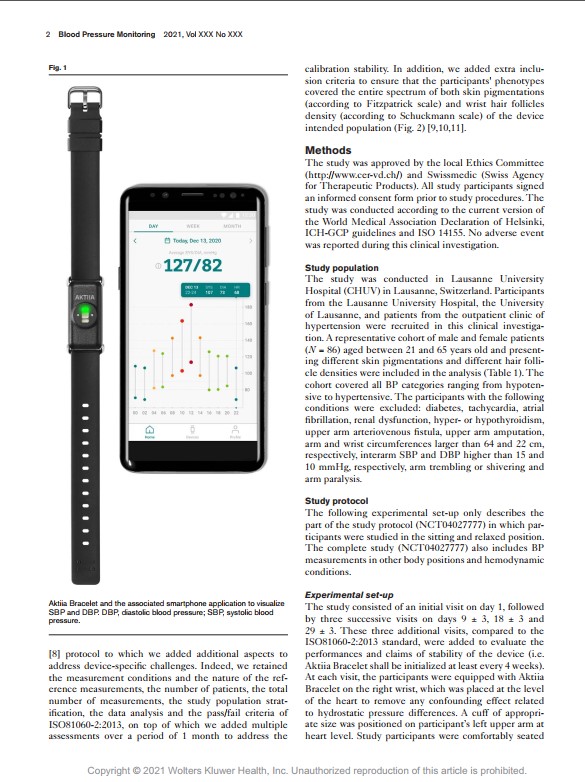
Blood pressure from the optical Aktiia Bracelet: a 1-month validation study using an extended ISO81060-2 protocol adapted for a cuffless wrist device
Blood pressure (BP) measurement is essential in the diagnosis and management of hypertension. As such, validation of BP measurement devices is of paramount importance in order to ensure accurate measurements [1]. To date, unvalidated devices dominate the online market, raising questions about adequate hypertension and cardiovascular management worldwide [2]. This lack of validation is specifically true for wrist-band wearables for which no specific recognized validation protocol exists so far. Nevertheless, cuffless measurement solutions have emerged recently with the associate hope of better hypertension management through BP telemonitoring [3]. These devices may increase convenience and patient empowerment in their disease management [4].
-
How Do I Manage Hypertension in Patients with Advanced Chronic Kidney Disease Not on Dialysis? Perspectives from Clinical Practice
Abstract: In the general population, the prevalence of moderate and severe chronic kidney disease (CKD) is usually below 5% but this figure is often higher in specific groups of patients such as those with type 2 diabetes. Patients with advanced CKD (CKD stage 3b and 4) are at high or very high cardiovascular risk, and their risk of progressing towards endstage kidney disease (CKD stage 5) and the need of renal replacement therapy are elevated. Hypertension is a major cause of poor cardiovascular and renal outcomes in severe CKD. Therefore, an adequate control of blood pressure (BP) is mandatory. However, normalizing BP is often challenging in these patients because the clinical management of hypertension in advanced CKD is not well defined and rarely supported by large randomized controlled trials. In the present review, we discuss the characteristics of hypertension in advanced CKD, excluding dialysis, and its management integrating data from recent clinical studies and a pragmatic approach enriched by a long-standing clinical experience.
-
The unsolved challenge of implementing sustained reductions of sodium intake in patients with chronic kidney disease
According to current nutritional recommendations, patients with chronic kidney disease (CKD) should restrict their salt intake and eat <90–100 mmol sodium (Na) per day [5–6 g sodium chloride (NaCl)/day]. The scientific basis of this recommendation is the strong evidence of a beneficial effect of reducing salt intake on two major targets of CKD management, namely blood pressure (BP) and proteinuria. Indeed, when compared with patients with a high urinary Na excretion, CKD patients with a lower Na excretion (100 mmol/day) had better BP control and lower proteinuria [1, 2]. Experimentally there is also increasing evidence that a high Na intake may have a detrimental effect on renal function, independent of BP, through direct effects on inflammatory processes and immune balance [3, 4]. However, evidence that being on a low salt diet reduces mortality and slows the progression of renal diseases in CKD is still low, despite an increasing number of retrospective and prospective observational studies suggesting a favourable impact of low Na intake on mortality and on renal function decline as reviewed in a recent editorial [5].
-
Clinical Profiles and Factors Associated with a Low Sodium Intake in the Population: An Analysis of the Swiss Survey on Salt
Abstract: As a part of the salt controversy, it has been suggested that people with a low sodium intake have an increased risk of cardiovascular events. However, there is no clear explanation for this increased risk. We examined the socio-demographic, clinical profile, and behavioral factors associated with a low sodium intake in the Swiss subjects who participated in the Swiss Survey on Salt. Only 13.3% of the Swiss population eat less than 5 g of salt daily and among them 78.2% are women. Subjects with a low sodium intake eat and drink less as reflected by lower intakes of proteins, potassium, and calcium and a smaller urine volume. In addition, a low blood pressure, a normal body mass index, a low prevalence of obesity, a low serum uric acid, and less alcohol and cigarette consumption characterized this group, suggesting a rather low cardiovascular risk profile. Being single and doing most of the cooking at home are associated with a low intake of sodium, as well as a less frequent consumption of meat and fish when eating less than 5 g salt per day. However, the awareness of the effects of salt on health and cardiovascular risk, health concerns, and physical activity are similar in subjects eating more or less salt. In conclusion, we could not evidence clinical or behavioral factors that could significantly increase the risk of developing cardiovascular events in low salt eaters.
-
Hypertension and Drug Adherence in the Elderly
Hypertension is highly prevalent after the age of 65 years affecting more than 60% of individuals in developed countries. Today, there is sufficient evidence from clinical trials that treating elderly subjects with hypertension with antihypertensive medications has a positive benefit/risk ratio even in very elderly patients (>80 years). In recent years, partial or total non-adherence has been recognized as major issues in the long-term management of hypertension in all age categories. However, whether non-adherence is more frequent in hypertensive patients older than 65 years or not is still a matter of debate and the common belief is that adherence is lower in older than in younger patients. Are clinical data supporting this belief? In this brief review, we discuss the topic of drug adherence in elderly in the context of the medical treatment of hypertension. Studies show that drug adherence is actually better in patients aged 65 to 80 years when compared to younger hypertensive patients (<50 years). however, in very old patients (>80 years) the prevalence of non-adherence does increase. In this patients’ group, there are specific risk factors for non-adherence such as cognitive ability, depression, and health believes, in addition to classical risk factors for non-adherence. One important aspect in the elderly is the prescription of potentially inappropriate medications that will interfere with the adherence to necessary treatments. In this context, an interesting new concept was developed few years ago, i.e., the process of deprescribing. Thus, today, in addition to conventional guidelines recommendations (use of single pill combinations, individualization of treatments), the evaluation of cognitive abilities, the regular assessment of potentially inappropriate medications, and the process of deprescribing appear to be three new additional steps to improve drug adherence in the elderly and thereby ameliorate the global management of hypertension.
-
Brainstem Correlates of a Cold Pressor Test Measured by Ultra-High Field fMRI
Brainstem Correlates of a Cold Pressor Test Measured by Ultra-High Field fMRI Mariëlle C. Hendriks-Balk, Fatma Megdiche, Laura Pezzi, Olivier Reynaud, Sandra Da Costa, Domenica Bueti, Dimitri Van De Ville and Grégoire Wuerzner
-
Comparative effectiveness of different antihypertensive agents in kidney transplantation: a systematic review and meta-analysis
Kidney transplant recipients have a 2-fold risk of cardiovascular (CV) disease compared with the general population [1]. Following transplantation, several factors have the potential to increase CV risk over time, including traditional risk factors [e.g. hypertension (HTN), diabetes], which are highly prevalent [2]. HTN, apart from being a primary CV risk factor, is the most common clinical problem among transplant patients, affecting at least 90% of this population [3]. Inadequate control of post-transplant HTN is associated with an increased risk of CV morbidity and mortality, other than being an independent risk factor for graft loss [4]. Several mechanisms, transplant-specific or not (e.g. elevated renin secretion by the recipients’ native kidneys, poor-quality donor kidneys, renal transplant artery stenosis [5]), are implicated in the pathogenesis of post-transplant HTN. In this context, immunosuppressive medications, essential to prevent acute rejection and graft loss, play a key role in promoting post-transplant HTN [6], as demonstrated in particular for calcineurin inhibitor use [7].
-
New Insights on the Role of Sodium in the Physiological Regulation of Blood Pressure and Development of Hypertension
A precise maintenance of sodium and fluid balance is an essential step in the regulation of blood pressure and alterations of this balance may lead to the development of hypertension. In recent years, several new advances were made in our understanding of the interaction between sodium and blood pressure regulation. The first is the discovery made possible with by new technology, such as 23Na-MRI, that sodium can be stored non-osmotically in tissues including the skin and muscles particularly when subjects are on a high sodium diet or have a reduced renal capacity to excrete sodium. These observations prompted the refinement of the original model of regulation of sodium balance from a two-compartment model comprising the extracellular fluid within the intravascular and interstitial spaces to a three-compartment model that includes the intracellular space of some tissues, most prominently the skin. In this new model, the immune system plays a role, thereby supporting many previous studies indicating that the immune system is a crucial co-contributor to the maintenance of hypertension through pro-hypertensive effects in the kidney, vasculature, and brain. Lastly, there is now evidence that sodium can affect the gut microbiome, and induce pro-inflammatory and immune responses, which might contribute to the development of salt-sensitive hypertension.
-
Is blood pressure measured correctly in dialysis centres? Physicians’ and patients’ views
Blood pressure (BP) is routinely measured as a vital sign before, during and/or after dialysis (peridialysis BP). Even if peridialytic measurements are widely used, the agreement with the interdialytic BP is poor and is often biased by many technical errors [1]. Since accurate BP measurements are critical for making decisions and evaluating a patient’s cardiovascular risk, Working Groups from the ERA-EDTA and the European Society of Hypertension (ESH) issued recommendations on standardized BP measurement in dialysis patients [2]. Previous studies have underlined substantial differences between recommendations for BP measurement in general and effective BP measurements performed by medical staff [3], but whether these recommendations are followed in dialysis centres has not been investigated so far. The objectives of this multi-centric, cross-sectional survey were (i) to assess the adherence to current recommendations [4] on BP measurements in dialysis centres both according to physicians’ and patients’ perspectives and (ii) to evaluate the use of out-of-office BP measurements in dialysis patients.
-
Compendium on the Pathophysiology and Treatment of Hypertension
The global epidemic of hypertension is largely uncontrolled and hypertension remains the leading cause of noncommunicable disease deaths worldwide. Suboptimal adherence, which includes failure to initiate pharmacotherapy, to take medications as often as prescribed, and to persist on therapy long-term, is a wellrecognized factor contributing to the poor control of blood pressure in hypertension. Several categories of factors including demographic, socioeconomic, concomitant medical-behavioral conditions, therapy-related, healthcare team and system-related factors, and patient factors are associated with nonadherence. Understanding the categories of factors contributing to nonadherence is useful in managing nonadherence. In patients at high risk for major adverse cardiovascular outcomes, electronic and biochemical monitoring are useful for detecting nonadherence and for improving adherence. Increasing the availability and affordability of these more precise measures of adherence represent a future opportunity to realize more of the proven benefits of evidence-based medications. In the absence of new antihypertensive drugs, it is important that healthcare providers focus their attention on how to do better with the drugs they have. This is the reason why recent guidelines have emphasize the important need to address drug adherence as a major issue in hypertension management.


Recent articles
- Poor Physician Adherence to Clinical Guidelines in Hypertension—Time for Physicians to Face Clinical Inertia

- Dietary sodium intake does not alter renal potassium handlingand blood pressure in healthy young males

- Management of hypertensive disorders inpregnancy: a Position Statement of the EuropeanSociety of Hypertension Working Group‘Hypertension in Women’

- Gout and hyperuricaemia: modifiable cardiovascular risk factors?
- Women’s health, cardiovascular risk and hypertension: the perspective still needs to improve